 Listen
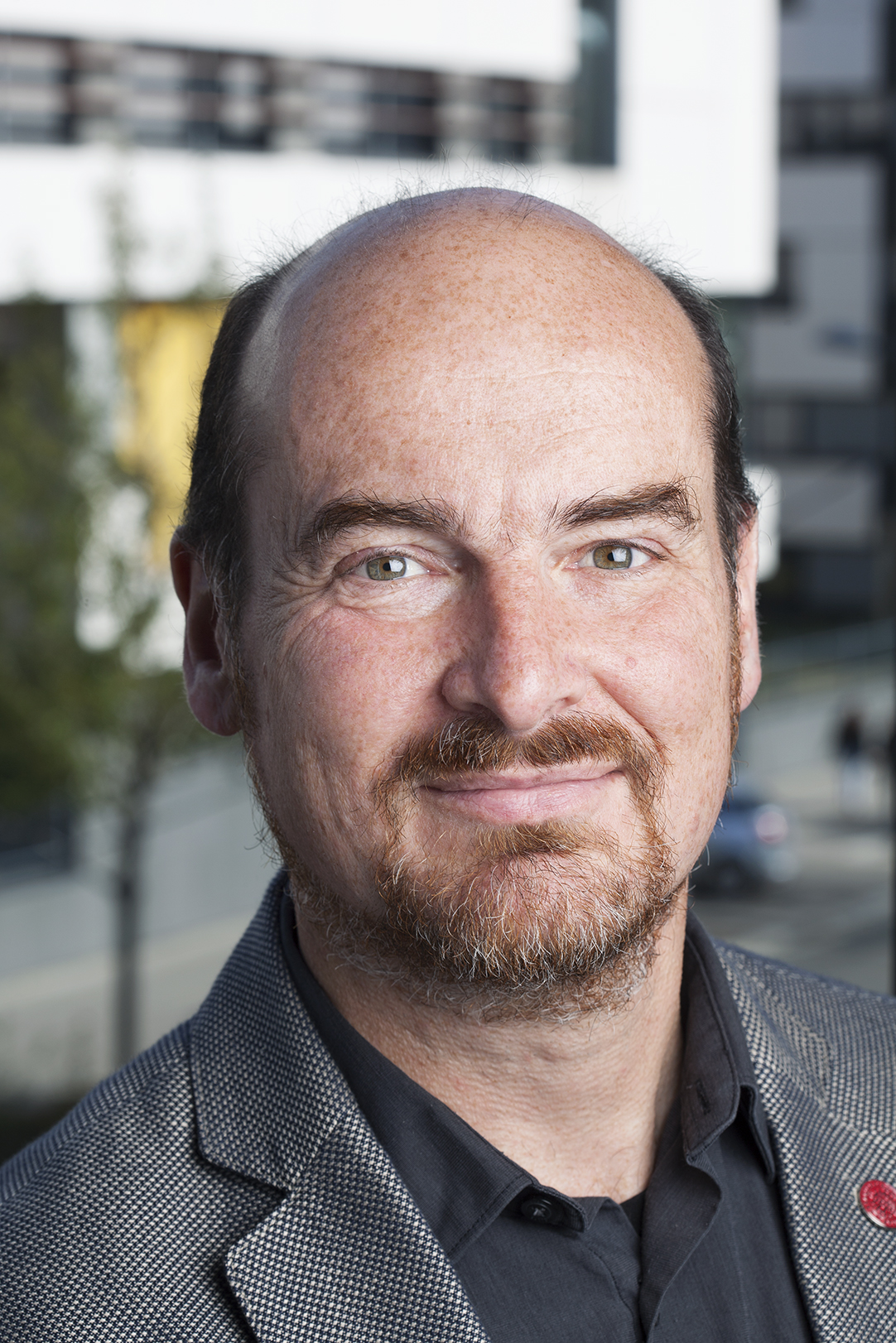 Professional Biography
After receiving his doctoral degree in mathematics at Uppsala University
in 1998, proving that the Lorenz attractor exists, Tucker spent two years at IMPA (Rio de Janeiro, Brasil) as a postdoctoral fellow.
During the years 2000 to 2002, Tucker held a H.C. Wang assistant professorship at Cornell University (Ithaca, USA) teaching and doing research in mathematics. During this period, Tucker was awarded the Swedish Mathematical Society's Wallenberg Prize, and the R.E. Moore Prize for Applications of Interval Analysis.
Upon his return to Sweden, Tucker was awarded a five-year research fellowship from the Swedish Royal Academy of Sciences.
In 2004, Tucker was awarded the European Mathematical Society's Prize for distinguished contributions in Mathematics.
In 2007, Tucker formed the CAPA group at the University of Bergen (Bergen, Norway). In 2009, the group moved to its current location at Uppsala University.
Tucker was promoted to full professor in 2011, and made Head of Department in 2014.
Members
Professor
Warwick Tucker
Computer-aided proofs in analysis.
Associate Professors
Denis Gaidashev
Dynamical Systems, renormalization, period doubling.
Jordi-Lluís Figueras
Computer-aided proofs in Dynamical Systems.
Postdocs
Florent Brehard
Rigorous Numerics, Formal Proofs, DynamicalSystems
Rodrigo Goncalves Schaefer
Arnold diffusion, Hamiltonian systems
Ph.D. students
Joel Dahne
Computer Assisted Studies in Fluid Mechanics.
Martin Andersson
Artificial intelligence.
Victor Linroth
Dynamical Systems.
Dan Lilja
Dynamical systems.
Alumni
Alejandro Luque [postdoc 2018-2019]
Computer-aided proofs in Dynamical systems
Yevgen Ryeznik [PhD student 2015-2019]
Methods for adaptive optimal design using nonlinear mixed effect models.
Viktoria Veselic [PhD student 2013-2018]
Applied dynamical systems/mathematical modeling.
Anna Belova [PhD student 2012-2017]
Dynamical systems.
Igors Gorbovickis [postdoc 2016-2017]
Dynamical systems
Isaia Nisoli [postdoc 2017]
Ergodic Theory, Rigorous Numerics
Natalia Zabzina [PhD student 2012-2017]
Applied dynamical systems.
Marina Gonchenko [postdoc 2015-2016]
Dynamical systems
Yasunori Aoki [postdoc 2014-2016]
Optimal design and model building methodology in pharmacometrics
Alexander Danis [PhD student 2007-2014]
Set-valued constraint propagation, with applications to pharmacokinetics.
Elio Mazzeo [postdoc 2013-2014, jointly with University of Toronto]
Dynamical systems
Mircea Voda [postdoc 2013-2014, jointly with University of Toronto]
Spectral theory for Schroedinger operators and Anderson localization,
geometric function theory
Peter Hazard [postdoc 2013-2014, jointly with University of Toronto]
Dynamical systems
Hanna Härdin [Postdoc 2012-2014]
Dynamics of slow-fast systems.
Ana Rodrigues [Research Fellow 2013]
Low-dimensional dynamical systems, ergodic theory, bifurcation theory.
Ferenc Bartha [PhD student 2008-2013]
Computer-aided proofs for boundary value problems.
Mioara Joldes [Postdoc 2011-2013]
Polynomial-based tools for rigorous computing.
Oswald Fogelklou [PhD student 2006-2012]
Computer-aided proofs for the viscous Euler equations.
Tomasz Kapela [Postdoc 2009-2011]
Computer-aided proofs in Hamiltonial dynamics.
Peter Gennemark [Postdoc 2008-2011]
Rigorous experimental design for pharmacokinetics.
Tomas Johnson [PhD student 2005-2009; researcher 2012-2013]
Computer-aided proofs in Dynamical Systems.
Daniel Wilczak [Postdoc 2007-2010]
Computer-aided proofs in Dynamical Systems.